

Chess and Surrealism: Paul Nougé and René Magritte
Chess played a significant role in the lives of Belgian surrealists Paul Nougé and René Magritte. Both were active in Brussels chess circles, and their fascination with the game extended beyond the chessboard.
In this well-documented study, Christophe Vandensavel explores their chess activities, friendships and correspondence, drawing on historical records and previously unpublished archival material. He also examines how chess strategy and its cognitive aspects influenced Nougé’s conception of poetry and surrealist artistic practices.
Originally published in French in 2024, this article is now made available in English to readers of the Chess History & Literature Society (CH&LS).
“Those Who Believe There Is Still a Game to Be Played”
Nougé, Magritte and the Game of Chess
by Christophe Vandensavel
Original publication: Christophe Vandensavel, « Ceux qui croyent qu’une partie reste à jouer » : Nougé, Magritte et le jeu d’échecs, Textyles, no. 66, Paul Nougé. La duplicité de l’esprit sincère, 2024, pp. 107–120. https://journals.openedition.org/textyles/6625
English translation published with the permission of Textyles.
Our knowledge of human beings, the emergence of their hidden possibilities, depends on the particular adventures in which their minds engage, whether these involve love, revolution, poetry, or pursuits that are at once more modest and more exceptional. It has come to be recognised that the latter can sometimes yield profound and valuable lessons. That is why the authors of this short work considered it worthwhile to devote sustained attention to the game of chess.
(Paul Nougé, Notes sur les échecs)
In the interwar period, the Brussels Surrealists distinguished themselves through their conception of writing (rejecting the automatism advocated by Breton’s group), their refusal to produce politically committed literature, and their literary habits (a disdain for the promotion of the literary personality, reflected in a taste for marginality and a desire to efface themselves from their own work)1. Nathalie Gillain has shown how Paul Nougé, the theorist and driving force behind the group’s activities, was wary of language and of the way it shapes humanity’s relationship with the world. He favoured a literary strategy akin to that of a chess player: the use of stratagems (rewritings, textual manipulations, pastiches, and so forth) that allowed his “moves” — made under cover of anonymity, pseudonyms or a collective voice — to challenge his “reader-opponent” enigmatically, while inviting that reader’s complicity in deciphering them2. This strategy of the writer as chess player — which might be illustrated by Magritte’s photograph of Nougé entitled Le Géant (The Giant) — was intended to enable the Surrealists to approach poetry with due caution, for unlike chess pieces, words are unpredictable and “if they can be handled at all, it is only with infinite care”3.
Seen in this light, the Surrealists’ means of carrying out their “moves” tended to consist in the (re)combination of elements of language, image or sound, removed from their original contexts and assembled to produce an effect “calculated, premeditated and directed against the viewer”4. As Robert Wangermee writes:
In his poems, Nougé showed that commonplaces could be transformed into “disquieting objects” through unexpected juxtapositions; he frequently used what he called “fragments of language”, fixed or semi-fixed conventions with their own internal coherence and pre-existing meaning. He handled them as raw materials, substituting one word for another, associating them through plays on sound and reversing their meanings. Magritte systematically defamiliarised familiar images by placing them in alien contexts, changing their material substance, or giving certain objects misleading names5.
In this respect, Paul Nougé explicitly draws a parallel between the poetic attitude and the practice of chess6. In this article, we seek to show that the literary strategy of the poet-chess player was rooted in the everyday lives of the Brussels Surrealists and bears witness to Paul Nougé’s commitment to studying chess and his interest in the cognitive processes involved in playing it. To this end, we will examine the Surrealists’ connections with the chessboard: their activities in chess clubs, their chess-related friendships and their performances. We will then consider the chess skills apparent in Notes sur les échecs and in Nougé’s manuscripts held by the Archives et Musée de la Littérature. In doing so, we hope to demonstrate that the poet-chess player was not merely a “pose” or an incidental metaphor, but rather a literary strategy and a set of methods of action arising from the sustained attention that Nougé and his associates devoted to the royal game.
The Surrealists at the Chessboard
Various sources attest to Nougé’s and Magritte’s chess activities: for a time they frequented chess clubs in the capital, as research undertaken at the Cercle Royal des Échecs de Bruxelles (CREB) shows; they played in cafés and in private; and they referred to the game in their correspondence with other artists.
The earliest traces of Nougé and Magritte in the CREB’s records date from the 1930s. It appears that around 1933 they belonged to the Cercle Philidor, which met at the Au Grand Monarque café, 29a avenue Marnix, until the establishment went bankrupt at the end of 1933, and then at the Old Tom tavern, on chaussée d’Ixelles near Porte de Namur7. That year, both took part in several tournaments in the third category; notably, they played one another in the first round of the club’s annual championship, a game won by Nougé8.
In 1934, the Philidor club merged with the Cercle de Bruxelles, and both men consequently became members of the Cercle des Échecs de Bruxelles et Philidor. That year, Nougé competed in the club’s annual championship in the third category9. Magritte, meanwhile, apparently entered the thirteenth chess-problem-solving competition organised by the newspaper La Nation, solving at least four of the six positions presented10. It should be noted that chess “problems” differ from games — although they share the same board, pieces and rules — in that they are specially composed for the exercise and set a task such as “White to play and checkmate in x moves”, whose solution must be demonstrated. This discipline, sometimes called the “poetry of chess”, has its own conventions of solving and its own criteria of aesthetic evaluation11.
In 1935, the Cercle des Échecs de Bruxelles et Philidor moved into premises on the first floor of the Café du Tunnel, 56 boulevard de Waterloo12. René Magritte entered a classification championship beginning at the end of that year and concluding in early 1936, again in the third-category group13. Nougé also took part and finished first. In the 1936 classification championship, there is no trace of Magritte; Nougé, however, competed in the second category following his first-place finish the previous year14.
Thereafter, traces of the Surrealists in the CREB’s records become scarcer. Following several mergers, the clubs mentioned above eventually gave rise, in 1973, to the Cercle Royal Échiquier de Bruxelles (CREB), which remains active today. There is, however, an amusing anecdote: around 1950–1955, Magritte resigned his membership of the CREB and, on that occasion, gave the club his painting Le Mat (or Échec et mat)15, as confirmed by the back cover of Notes sur les échecs16. Painted around 1936, the work depicts a chessboard on which attention is drawn to the white king being placed in check, stabbed by a black bishop. Both pieces are personified, while the remaining pieces, which seal the king’s checkmate, were inspired by the chess set created by Man Ray in 192017. The painting is said to have hung in the back room of the café where the club met before being stored in an attic, rediscovered in the late 1960s and sold to a private collector18. Quite a journey!
Magritte and Nougé are also thought to have frequented the Cercle Edgard Colle, formerly known as Le Cygne because its first meeting place was the Café Le Cygne, 9 Grand-Place. Magritte is known to have visited several cafés, including the Taverne Greenwich, 7 rue des Chartreux, long a haunt of devotees of the sixty-four squares. According to oral tradition, however, it was at the Café Le Petit Rouge, place Saint-Jean, that he produced several drawings by hand in 1950 for issue 5 of the bulletin of the Le Colle club19. In his book Magritte, Livre l’image, Tristan Schwilden explains that Nougé wrote an unsigned article for the occasion, entitled “Les Échecs vus par René Magritte” (“Chess as Seen by René Magritte”), to accompany the two illustrations. One depicts three “bilboquets à museaux” (cicerones), while the other shows a leaf next to a hand holding a chess pawn20.
Alongside their visits to chess clubs and cafés, chess also left its mark on the artistic social lives of the Brussels Surrealists. Some of Magritte’s letters, for instance, refer directly to relationships enlivened by the game. On 10 August 1950, he sent Julien Gracq a letter that began as follows21:
Dear Mr Gracq,
I receive your “latest moves” just as I am managing to wean myself off chess. In any case, I think it would be sensible for me to resign both games, in which your advantages are so clear that my defeat is only a matter of time. So, “I resign”. I hope that perhaps we shall have the opportunity to play together without the interminable recourse to correspondence.
The two men were therefore engaged in at least two correspondence games, in which the players sent their moves to one another by post in turn. Magritte resigned both games, playing White in one and Black in the other.
PGN Viewer powered by chesstempo.com
PGN Viewer powered by chesstempo.com
Although Magritte had resigned from the CREB, his interest in the game seems to have endured. An exchange with Marcel Duchamp in October 1965 provides evidence of this. Duchamp thanked him “for agreeing to take part in the exhibition at Ekstrom’s (Feb. 66) for the benefit of the USA Chess Foundation” and added: “The young Bobby Fischer is certainly a miracle of nature, but I greatly fear that success will go to his head and that, in the end, he will never become more than one of the world’s twenty-five best players. Do you play much? I no longer do — except for amusement”22. This letter followed Magritte’s positive reply, written directly on the invitation card Duchamp had sent him. That card was combined with those of the other artists who had confirmed their participation to form the background of Duchamp’s poster Hommage à Caïssa, announcing the event to be held from 8 February 1966 at the Cordier & Ekstrom Gallery in New York23. Magritte wrote on the card: “I send you this encouragement for the ‘noble game’ [...] Just happening to meet O’Kelly this afternoon, who is preparing a book on chess”24.
Duchamp’s fascination with chess is well known: he had been a master of the French federation since 1925 and had competed in high-level tournaments, including four Olympiads representing France25. Beyond the anecdote, however, the correspondence reveals Magritte’s continued interest in the game. That day he was due to meet Albéric O’Kelly de Galway, several times Belgian champion and a Belgian grandmaster, whose reputation was already firmly established in 196526. The exchange also gives us an example of discussion of contemporary chess news, marked by the rise of Bobby Fischer. Fischer would become world champion in 1972 by defeating Boris Spassky and, against the backdrop of the Cold War, end Soviet domination of the world championship.
Finally, Denis Marion (the pseudonym of Marcel Defosse), with whom Nougé embarked on the project that would lead to Notes sur les échecs and, in Marion’s case, to La méthode intellectuelle d’Edgard Poe27, was also an accomplished player. A first-category player in 193328, he subsequently took part in several national championships29, as well as the 1937 Chess Olympiad, alongside O’Kelly, representing Belgium30. He also co-authored a “beginner’s manual”31 with Frits Van Seters, a first-category player and several-times champion of the Belgian federation32.
Chess thus seems to have been firmly embedded in the everyday lives of the Brussels Surrealists, both socially (through club membership and chess friendships) and in practice. On the evidence of surviving games, we can say that Magritte appears to have remained a third-category player for a period of time. Unfortunately, no game by Nougé has yet come to light that would allow us to assess his playing strength. His Notes sur les échecs and certain archival materials nevertheless provide insight into his chess knowledge.
Nougé and Chess Thinking
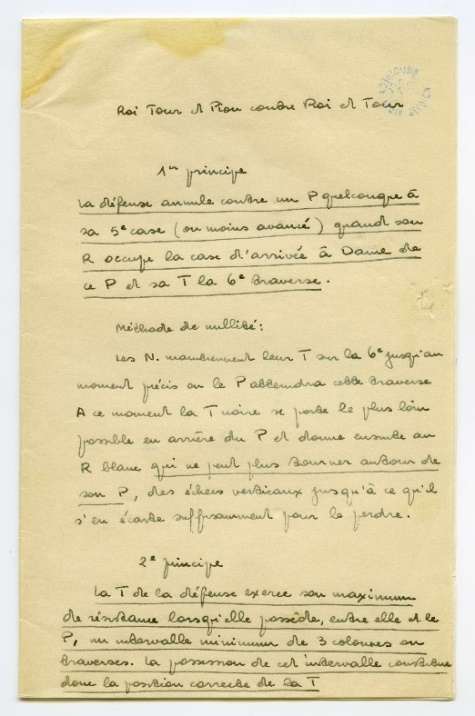
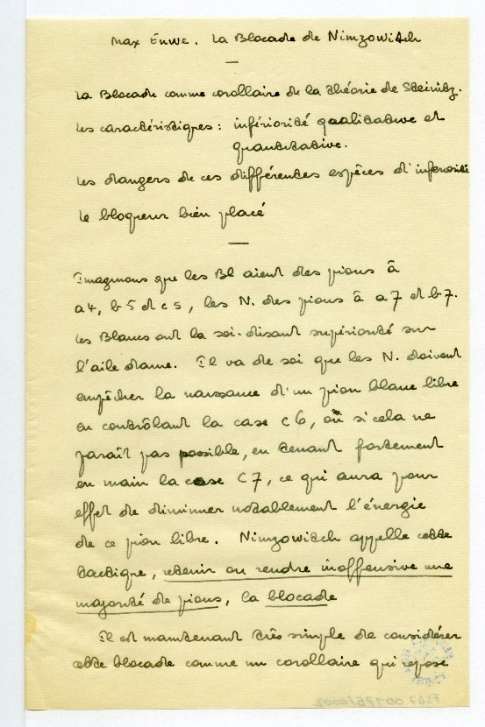
To prepare for future games, Paul Nougé kept, among other things, a list of openings-related subjects to study (openings to learn or review, the best defence against particular formations)33, and he produced handwritten notes and small teaching cards outlining certain theoretical endgame positions34. He supplemented his preparation for the various phases of the game by reading general works (such as Xavier Tartakower’s Bréviaire des échecs35) and more specialised books (such as Max Euwe’s La blocade de Nimzowitsch36, devoted to a strategic theme).
Nougé also seems to have taken an interest in analyses of master games. From studying such games he argued that, “setting aside what might be called accidental factors: distraction, errors of judgement, winning or losing the game”37, one could discern “differences in quality” distinguishing the master from the amateur. He added that “the average player, reading through a master’s game, suddenly feels that it moves on a higher plane, one that he can glimpse only briefly and from afar”38.
In the pre-computer era, the games of the masters provided the reference material on which chess theory was built. Their combined contributions form a legacy whose history constitutes “chess culture”. Nougé appears to have been familiar with it when he alluded to players at the Café de la Régence (Légal and Philidor)39, active in eighteenth-century Paris, or to more recent masters such as Aron Nimzowitsch, José Raúl Capablanca, Alexander Alekhine and Richard Réti, whose theoretical contributions and respective styles he discussed40. He also drew upon this culture when citing Steinitz and a Réti–Capablanca game to illustrate that positional play and combinational play — which “textbooks too often allow us [...] to imagine [...] as two aspects of the game corresponding to profoundly different mental attitudes” — are separated “not by a difference of kind but merely by a difference of emphasis”41. Here we again encounter Nougé’s distrust of everyday language and the way it shapes our relation to reality. Above all, however, we wish to highlight his attention to the cognitive aspects of playing chess.
As an informed chess player, Nougé understood that “once familiarity with the elementary movement of the pieces and their reciprocal actions has been acquired [...] the game begins”42. It is governed by strategy — involving medium- or long-term plans based on particular features of the position — and by tactics, aimed at obtaining a (very) short-term advantage, such as winning a piece or pawn or forcing checkmate. As positions succeed one another, the player must combine analysis and calculation — which Nougé explicitly distinguished43 — on the basis of “renewed observation”, that is, “a mental movement punctuated by countless returns to the most concrete external reality and continually corrected in the light of it”44. But the task is complex, for “on the chessboard it is essential [...] to know what to observe”45. To make appropriate decisions, the player must rely on a “method”, which Nougé described as a set of “procedures that are extremely personal and difficult to communicate to others”46.
Nougé’s reflections on the inner life of the chess player find an echo in contemporary cognitive psychology research. Studies of chess players suggest that visual recognition of piece configurations (patterns), working closely with memory, forms the basis of master-level performance47: through experience and study, players seem gradually to develop visual heuristics that allow them to identify relevant information in a position more quickly and thus “know what to observe”48. This segmented perception of the chessboard enables experienced players, on the one hand, to analyse the features of a position — assessing it and considering a plan of action or typical procedures49 — and, on the other, to manipulate a mental representation of the position in working memory for purposes of calculation (imagining sequences of moves from a given position)50. Decisions made on this basis are not infallible, however. Nougé observed that “the blunder51 scarcely requires explanation in the case of a beginner” but is “sometimes singularly mysterious among masters [...] One may think [...] that the richer the mind is in dynamic images, the more likely the projection of those images onto the chessboard is, as a result of some minor mental incident, to obscure the real situation from view”52. In cognitive psychology, this evokes the notion of “interference”53 between mental representation and visual input.
Ultimately, the player must decide on the next move. The amateur may refer to the fundamental principles of chess, which can serve as decision-making heuristics54, whereas the master can draw on experience and study to approach positions with greater confidence and, when necessary, calculate long, concrete sequences of moves to confirm or challenge what theoretical principles would suggest:
In chess, the most difficult, if not the essential, conquest is freedom. It exists only at the extremes. Through unconsciousness and ignorance, it is found in the beginner. It reappears among the masters. In between [among amateurs], it vanishes under the weight of mediocre knowledge, automatisms and clichés. A truth that extends far beyond the chessboard, a far more general truth. Poetry, painting, war, revolution55.
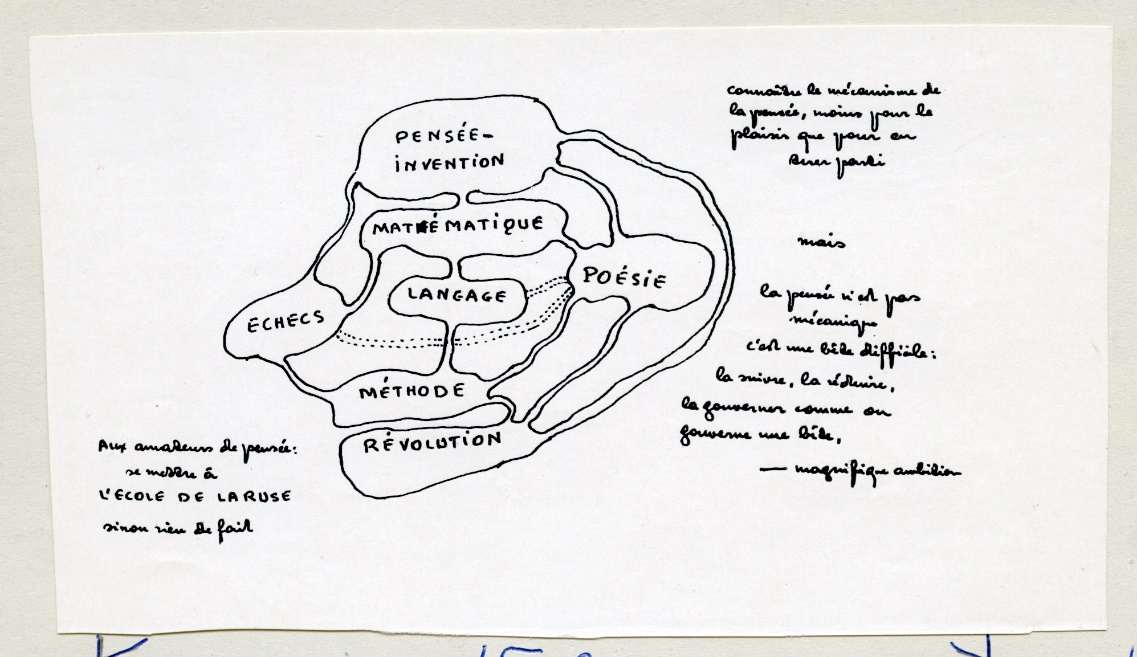
Paul Nougé thus emerges as someone eager to improve and quite familiar with chess culture, but above all as a “lover of thought”, attentive to the mental resources brought into play at the chessboard. It therefore seems that Nougé’s understanding of the mental attitudes required for both chess and poetry was well informed: in his conception, they arise from the same movement of thought56 and employ a comparable method, governed by cunning. The parallel Nougé drew between them is especially apparent in one of his own “images of thought”57 58:
Fascinated by the power of generalisation and analogy, Nougé presents a network of ideas that preoccupied him. Although the ideas are interconnected, he considered it necessary to add a dotted link between “Poetry” and “Chess”, as though to emphasise the parallel he perceived between the two practices. In both, mental activity tends towards a strategy and — anticipating certain effects — calculates moves and combinations through a personal “method”. Since signs (words, images and sounds) are more “unpredictable” (ambiguous) than chess pieces, it is all the more important to exercise caution and practise “renewed observation”: in other words, to compare intended effects with actual effects and adapt accordingly. This means treating the reader or viewer as an opponent rather than as someone already defeated59. Finally, all these ideas revolve around the notion of revolution, subordinating these practices to the subversive ethical project adopted by the Surrealists60.
Conclusion
The social relationships of Paul Nougé and René Magritte thus testify to a sustained interest in chess. The Brussels group’s theorist and driving force devoted considerable attention to chess thinking, shedding light — from the perspective of his everyday concerns — on the parallel he drew between chess and poetry. In Nougé’s conception, the figure of the “poet-chess player” therefore appears to be more than an ethos or a simple metaphor. Rather, it knowingly refers to a poetic practice governed by a strategy directed towards the group’s subversive ethical objective61. Instead of trying to subject language to pre-established theoretical principles (ideological or formal62), poetic practice is conceived in terms of means of action and relies on the (re)combination of existing motifs.
Examples abound63, but as an illustration we invite readers to compare Magritte’s “images” entitled La belle lurette (1965)64, Le temps jadis (1966)65 and L’art de la conversation (1967)66. Although late works, they make particular use of chess motifs. All three are similarly composed and show, in the right foreground, a figure whose body is a chess piece and whose head is either that of a bird or, in the other two cases, an eye. The background depicts a fire, a tower, or two figures seen from behind (whom we imagine to be conversing). These compositions take a piece out of its usual chessboard context and unsettle the viewer by exploiting the dual nature of chess pieces. On the one hand, they evoke a “represented and embodied cast of characters [...] bishops, knights, queens, etc.”67, endowed with evocative potential; on the other hand, they “are in fact nothing but vectors, that is to say a set of parameters (directions, ranges, etc.) which could remain pure abstractions, adequately characterised without recourse to the shapes that embody them on the chessboard”68. Taken together, these are images with similar compositions in which certain motifs from Magritte’s work are (re)combined to unsettle the observer69.
In the light of this discussion, the members of the “Brussels group” appear to us — in their relationship with the world, the artistic fields and the chessboard — as “those who believe there is still a game to be played”70.
PDF version of the article
1 Aron (Paul), « Les groupes littéraires en Belgique et le surréalisme entre 1918 et 1940 », dans Textyles, n°8, 1991, p. 9-27.
2 Gillain (Nathalie), « Du Géant à l’échiquier. Paul Nougé au pied de la lettre », dans Dewez (Nausicaa) et Martens (David), dir., Interférences littéraires, nouvelle série, vol.1, n°2, « Iconographies de l’écrivain », 2009, p. 113-137.
3 Nougé (Paul), Journal (1941-1950) suivi de Notes sur les échecs, Bruxelles, Didier Devillez Editeur, 1968, p. 168.
4 Gillain (Nathalie), op.cit., p. 117.
5 Wangermee (Robert), « Penser d’une manière musicale, selon Paul Nougé », dans Textyles, n°26-27, 2005, p. 72-78.
6 Nougé (Paul), op.cit., 1968, p. 171.
7 Cornil (Étienne), Les Cahiers du CREB, n°14, Bruxelles, Cercle Royal des Échecs de Bruxelles, 2023, p. 10.
8 Ibid., p. 13.
9 Ibid., p. 15.
10 Ibid., p. 16-17.
11 Seneca (Camil), 150 problèmes d’échecs, Les Nouvelles Editions Marabout, Verviers, 1979, p. 9-41.
12 Cornil (Étienne), op.cit., p. 18.
13 Ibid., p. 22-23.
14 Ibid., p. 24.
15 Ibid., p. 31.
16 Nougé (Paul), Notes sur les échecs, Bruxelles, Les Lèvres Nues, 1968.
17 Marek (Yves), Art, échecs et mat, Paris, Imprimerie nationale édition, 2008, p. 101.
18 Cornil (Étienne), op.cit., p. 31.
19 Cornil (Étienne), « Le pion f. », Bulletin officiel de la Fédération Echiquéenne Francophone de Belgique, no. 185, https://www.fefb.be/images/Pionf/PION%20F%20185.pdf, accessed 10/02/2024, 2020, p. 481.
20 Ibid.
21 Magritte (René), signed autograph letter to Julien Gracq, 10 August 1950, Brussels, Collection de la Maison Magritte.
22 Duchamp (Marcel), signed autograph letter from Marcel Duchamp to René Magritte, New York, 26 October 1965, private collection.
23 Duchamp (Marcel), Hommage à Caïssa, exhibition poster, Cordier and Ekstrom, New York, 1966, https://www.duchamparchives.org/amd/archive/component/SBK4_1966-67_20/fr/, accessed 13/02/2024.
24 Ibid.
25 Troche (Sarah), « Marcel Duchamp et les échecs : “ tous les joueurs d’échecs sont des artistes ” » dans Mussou (Amandine), Troche (Sarah), Le jeu d’échecs comme représentation. Univers clos ou reflet du monde ?, Paris, éditions Rue d’Ulm, 2009, p. 81-93.
26 Cornil (Étienne), « O’Kelly de Galway, » dans Vannerom (René), Journal du CREB, n°41, 2003, p. 9.
27 See Denis Marion’s foreword (1969) in Nougé (Paul), Journal (1941-1950) suivi de Notes sur les échecs, Brussels, Didier Devillez Editeur, 1968, p. 151.
28 Cornil (Étienne), op.cit., p. 12.
29 Cornil (Étienne), Les Cahiers du CREB, n°1-2, Bruxelles, Cercle Royal des Échecs de Bruxelles, 2009.
30 This is evidenced by the fourteen games played between 1934 and 1942, available from the online chess database chessgames.com, https://www.chessgames.com/perl/chessplayer?pid=37006, accessed 03/02/2024.
31 Defosse (Marcel), Van Seters (Frits), « Le jeu d’échecs », Les éditions Lumière, Bruxelles, 1944.
32 Cornil (Étienne), op.cit.
33 Nougé (Paul), Cartons avec notes sur les échecs, manuscript, Archives et Musée de la Littérature (AML), FS4700175/0004.
34 Ibid.
35 Nougé (Paul), Journal (1941-1950) suivi de Notes sur les échecs, Bruxelles, Didier Devillez Editeur, 1968, p. 169.
36 Nougé (Paul), Max Euwe. La blocade Nimzowitsch, undated manuscript, AML, FS4700175/0002.
37 Nougé (Paul), Journal (1941-1950) op.cit., p. 165.
38 Ibid.
39 Ibid., p. 154.
40 Ibid., p. 169.
41 Ibid., p. 166-167.
42 Ibid., p. 157.
43 Ibid., p. 156.
44 Ibid., p. 163.
45 Ibid., p. 159.
46 Ibid., p. 156.
47 Chassy (Philippe), Anic (Darko), Psychologie du joueur d’échecs, Saint Paul, Olibris, 2012, p. 19-24.
48 Ibid., p. 27.
49 Ibid.
50 Ibid.
51 A blunder (??) is a type of chess error in which a move unjustifiably gives the opponent a large advantage (material gain or a mating attack). In chess annotation, it is distinguished from dubious moves (?!), mistakes (?) and inaccuracies.
52 Nougé (Paul), op.cit., p. 170.
53 Chassy (Philippe), Anic (Darko), op.cit., p. 81-84.
54 Chassy (Philippe), Anic (Darko), op.cit., p. 153-162.
55 Nougé (Paul), op.cit., p. 166.
56 Ibid., p. 171.
57 In the sense used by Caraes (Marie-Haude) and Marchand-Zanartu (Nicole), Images de pensée, Paris, éditions de la Réunion des musées nationaux, 2019.
58 Nougé (Paul), Aux amateurs de pensée : se mettre à l’école de la ruse – sinon rien de fait, printer’s proof, undated, AML, FS4700184/0003-0004.
59 Nougé (Paul), op.cit., p. 168.
60 Gillain (Nathalie), op.cit., p. 117.
61 Ibid.
62 Nougé (Paul), op.cit., p. 167-168.
63 See Gillain (Nathalie), op. cit., or Gillain (Nathalie), « La subversion des images et des clichés littéraires, par Paul Nougé », in Textyles, no. 43, 2013, pp. 27–40.
64 Magritte (René), « La belle lurette », 1965, Collection privée.
65 Magritte (René), « Le temps jadis », 1966, Collection privée.
66 Magritte (René), « L’Art de la conversation », drawing, Galerie Retelet, Monaco, 1967.
67 Berchtold (Jacques), « Échiquiers d’encre. Introduction » dans Berchtold (Jacques), Échiquiers d’encre. Le jeu d’échecs et les lettres (XIXe-XXe siècles), Genève, Droz, 1998, p. 17.
68 Ibid.
69 Magritte exploits this duality by depicting figures whose bases resemble familiar chess pieces but cannot be identified or assigned a clear pattern of movement. At the same time, he personifies these inanimate pieces by adorning them with features of living beings (an eye, a bird’s head). The bird’s head also recalls, for an attentive viewer, the summit of the mountain in « Le Domaine d’Arnheim » (1962), and the figures identical to those seen conversing in the sky in « L’Art de la conversation ». The same contrast was already present in « Échec et mat » (c. 1936), where the white king, threatened by a black bishop, attracts attention. Both are personified, whereas the remaining pieces are inspired by Man Ray’s 1920 chess set.
70 Based on an idea by Nougé, mentioned in Magritte (René), signed autograph letter to Jacques [Meuris], 1947, private collection.